


OKRs vs KPIs: there’s one mistake that wrecks OKR programs before they even get off the ground.
Hand your team a list of KPIs and ask them to pick which ones should become Key Results. It sounds logical. It feels efficient. It’s what most teams do. And it’s exactly how OKRs go sideways.
I know because I did it myself in my early coaching days. This is the first post in a series called How to Fail with OKRs, and I figured I’d start with the mistake I’m most guilty of.
Table of Contents
My First OKR Project
The first time I coached a mid-sized software company on OKRs, I walked into the room prepared. I had pulled industry-standard KPIs for every functional area. HR got a list from the APQC Process Classification Framework. Marketing got their standard metrics. Sales got theirs.
Before I even asked the teams what they were trying to achieve, I showed them the menu.
“Pick the ones that matter most. Those become your Key Results.”
I thought I was being helpful. I was being a waiter.
OKRs vs KPIs: The Salad Dressing Problem
This is the heart of the OKRs vs KPIs confusion — teams treat them as interchangeable when they’re not.
Here’s what I mean. Imagine you sit down at a restaurant and the waiter asks what dressing you want on your salad. You say, “What are the options?” They list four. You pick one.
That’s alternative-focused thinking. You let the available choices define what’s possible.
What is Value-Focused Thinking?
Imagine a different version. The waiter asks what dressing you want, and you say, “Actually, I don’t need dressing. Could I get some balsamic vinegar on the side?”
That’s value-focused thinking. You came in knowing what you actually wanted, and you used your values, not the menu, to decide.
When I handed teams a list of KPIs and asked them to choose, I was the waiter with the limited menu. I was nullifying their knowledge of their own business, shutting down creativity, and forcing them into an alternative-focused approach to something that demands the opposite.
OKRs should be value-focused. Always.
A Real Coaching Example
Let me show you what this looks like in the wild. I was working with a marketing director recently and asked a simple question.
Me: What’s the most important area for your team to improve next quarter?
Marketing Director: The ROI of our marketing events and campaigns.
Me: Great. How will we know at the end of the quarter that you’ve improved it?
Marketing Director: Oh, we’ve got tons of metrics. Click-through rate, bounce rate, unsubscribes, email open rate, time on page…
Me: I’m not asking what you’re currently tracking. I’m asking what would actually reflect improvement.
Marketing Director: Well, we could go with email open rate.
Me: What’s it at now?
Marketing Director: Four percent.
Me: What would it need to be to represent real improvement?
Marketing Director: Are you kidding? Four percent is amazing. We just want to keep it there. Even three percent would be fine.
That right there is the trap. Email open rate wasn’t a Key Result. It was a health metric, something they were monitoring to make sure it didn’t get worse. Health metrics are not Key Results. Key Results measure improvement, not maintenance.
The team was reaching for what was already on the dashboard because the dashboard was their menu. They weren’t measuring what mattered. They were measuring what was easy to find.
Two Warning Signs Your OKR Drafting Is Broken
If you’re drafting OKRs and either of these is true, you’ve fallen into alternative-focused thinking:
- You started with a spreadsheet of existing metrics. The conversation begins with “which of these should we use?” instead of “what do we actually want to change?”
- Your draft Key Results all reflect things you’re already tracking. No new baselines. No new instruments. Just a reshuffle of the current dashboard.
When this happens, your OKRs end up reinforcing the status quo instead of pushing the team somewhere new. You’re tracking activity, not driving improvement.
OKRs vs KPIs: The Right Way to Start
Drafting OKRs should begin with your team’s vision, not a database of industry KPIs. Ask broad, uncomfortable questions first:
- What is the single most important objective for this quarter?
- Why this one? Why now?
- What needs to be true at the end of the quarter for us to call this a win?
- What would we need to start measuring that we’re not measuring today?
That last one is the breakthrough. The marketing team I coached eventually realized they needed a new baseline metric tied directly to event ROI. That meant building new tracking before the quarter even started which was harder. It was also the only path to a Key Result that would actually move the business. For more on writing great OKRs, check out the 7 steps for setting effective OKRs.
The Core Message
The OKRs vs KPIs distinction matters. KPIs aren’t bad. They’re useful. But they shouldn’t drive your OKRs.
KPIs aren’t bad. They’re useful. But they shouldn’t drive your OKRs.
Here’s a summary of OKRs vs KPIs and how they compare. In fact, it’s really KRs vs KPIs in this case.
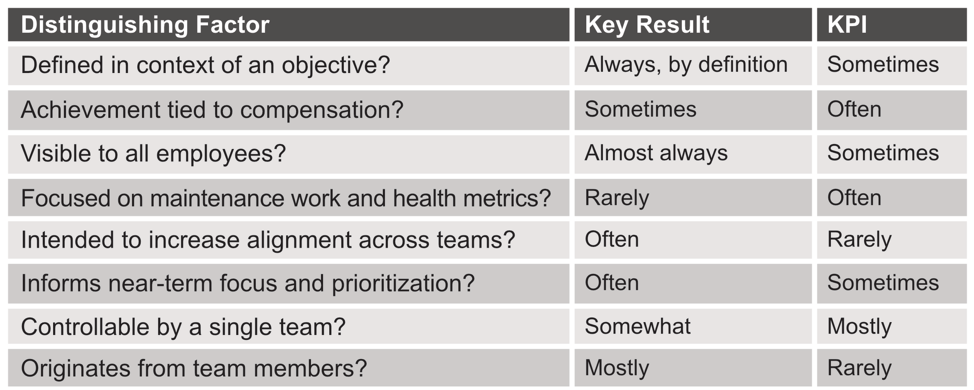
OKRs vs KPIs (Taken from The OKRs Field Book)
OKRs start with vision, priorities, and values. Then, and only then, do you figure out the right Key Results to measure progress. If you flip that order, you’ll end up with a polished dashboard and a team that’s no better off than they were last quarter.
Don’t be the waiter with the menu. Be the diner who knows what they want.
🎧 Listen to the full episode below.
Stuck on OKRs?
Book a free 30-minute strategy call. We’ll diagnose what’s blocking your team and you’ll leave with two or three concrete next steps, whether or not we end up working together.


Recent Comments