

What Makes a Strong OKR Example?
Seeing real OKR examples is one of the fastest ways to understand how Objectives and Key Results work in practice. The framework, popularized by John Doerr in Measure What Matters and used by Google, Intel, and thousands of high-performing teams, only works when the OKRs themselves are well-written.
Many teams struggle with OKRs not because they lack effort, but because their OKRs are vague, activity-based, or simply restate financial targets rather than guiding execution.
Strong OKRs focus on clear outcomes, measurable progress, and the few drivers that truly determine success.
Weak OKRs often look like a to-do list, lack a baseline, or fail to focus teams on what matters most. While weak OKRs often measure work completed, strong OKRs guide the daily decisions and behaviors that produce results.
If you’d like to explore more real-world OKR examples and good vs bad OKR comparisons used by our clients to drive measurable business results, visit our OKR Examples Library, where you can see how weak OKRs evolve into strong, outcome-driven OKRs. The library includes examples from Finance, User Experience (UX), Facilities, and more.
Since we advise starting OKR initiatives with top-level OKRs, let’s begin with a company-level OKR for a small SaaS company based on work with a recent client.
First, Why Use OKRs at All?
Before diving into examples, it helps to understand why thousands of companies have adopted Objectives and Key Results. OKRs work because they force three things most strategic plans skip: a clear focus on what matters most this quarter, transparent measurement so everyone knows what progress looks like, and an explicit commitment to outcomes rather than activity.
When teams implement OKRs well, they stop confusing busyness with progress. Strategy stops living in slide decks and starts driving daily decisions. Cross-functional alignment becomes natural rather than forced. The framework was popularized by Andy Grove at Intel, refined by John Doerr, and adopted by Google before spreading across the industry. But adoption alone doesn’t guarantee success.
Most teams that adopt OKRs eventually abandon them, usually within two cycles, because they never wrote OKRs that actually drove behavior. That’s exactly the problem the examples in this post are designed to solve.
Company-Level OKR Example (Small SaaS Company)
Many companies begin with OKRs focused purely on financial outcomes. While revenue and profitability matter, they are lagging indicators. They do not provide focus or drive desired behaviors. In this example, I will not specify OKR cycle times and every single stretch/commit level; rather these examples focus on what makes an OKR effective.
Weak Company OKR Example
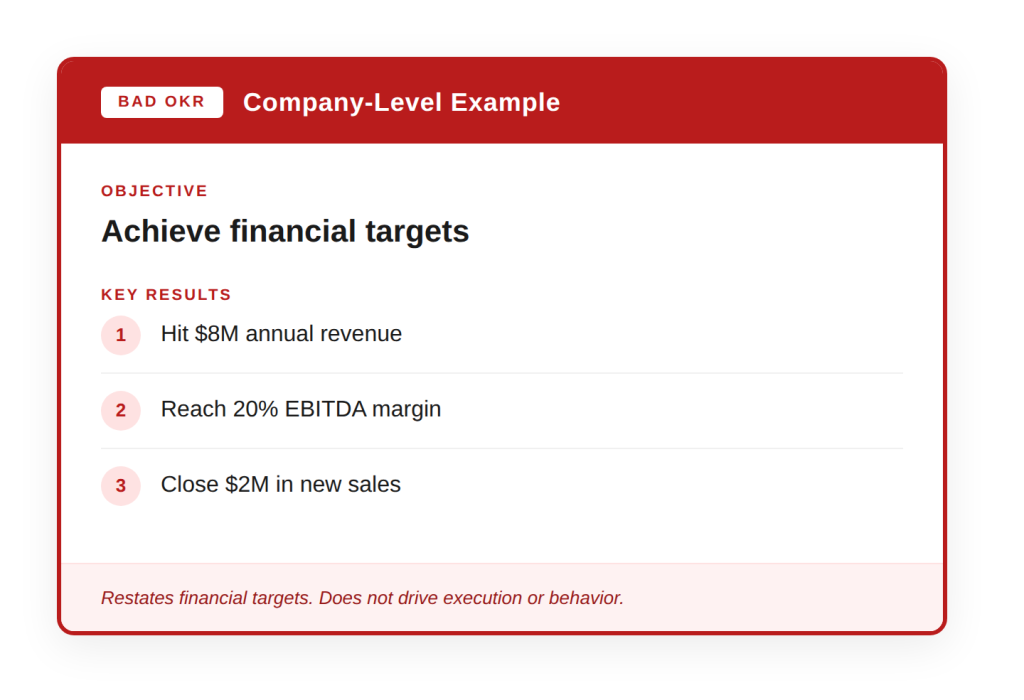
Bad OKR above that does not help drive execution. It simply restates financial targets.
Next, let’s look at aniImproved company OKR example (retention as the driver)
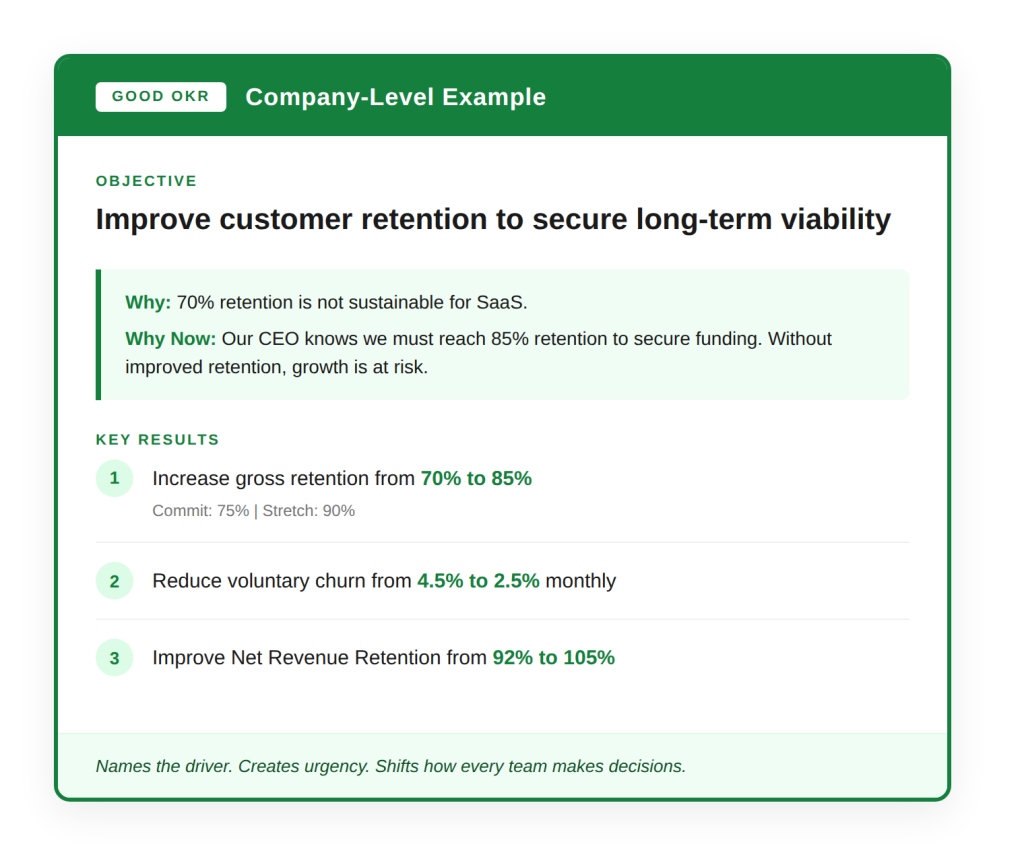
Good OKR above that helps drive execution.
Recognize this in your own OKRs?
Most teams have at least three of these problems and don’t see them.
Book a free call with BenWhat Changes Because of This OKR?
- Product and Customer Success begin analyzing churn drivers rather than just reviewing monthly revenue trends.
- VP Sales launches new incentives so reps get paid for annual renewals, not just the initial close; reps target higher-fit customers who are more likely to renew.
- Marketing stops creating collateral for new prospects and starts creating case studies and tips from users to target their current install base. They launch their first “annual user conference” and see a spike in retention!
These two OKR examples illustrate the difference between simply measuring financials and driving retention.
The bad OKR example fails to answer the most basic OKR question: What is the most important area to focus on to make progress in the near term?
The good OKR examples not only answers this question, but it also reveals: Why retention is the focus (to educate the team) and why now (to create urgency).
Marketing Team OKR Examples
Weak Marketing OKR
Objective: Improve marketing performance
Key Results:
- Launch new website
- Run 3 campaigns
- Get 100 leads
The first two key results look like activities on a to-do list that reflect output, not measurable outcomes. “Get 100 leads” is not written as “x to y” so we don’t know if getting 100 leads is an improvement over our current performance. Amazingly, some of the OKR examples out there look just like this! These are terrible key results.
Improved Marketing OKR Examples
Objective: Increase qualified demand from target segment XYZ
- Why: Segment XYZ customers are 3x more valuable than other segments on average. This lifetime customer value is the key to sustainable growth.
- Why Now: Other segments are growing at a steady-state, but segment XYZ is showing exponential potential growth and is our key differentiator right now in the market.
Key Results:
- Increase marketing-qualified-leads (MQLs) in segment XYZ from 1,200 → 1,800
- Improve conversion rate on segment XYZ landing pages from 2.1% → 3.2%
What Changes Because of This OKR?
- Marketing evaluates campaigns based on qualified lead quality, not just volume.
- The team runs conversion experiments focused on segment XYZ instead of somewhat randomly launching new content.
The improved OKR changes how decisions are made. Now, marketing is focused on activities that connect directly to the strategy to get more traction in segment XYZ. Seem simple? It is! When OKRs are working well, teams have clarity. They understand where to focus effort to make measurable contributions that best execute your company’s strategy.
Bad vs Good OKR Examples by Function
Below are additional examples showing how better KRs shift behavior.
Sales Team OKR Examples
| Bad Key Result | Good Key Result |
| Conduct 50 demos | Increase win rate from 22% → 32% |
| Hire 3 sales reps | Increase pipeline coverage from 2.0x → 3.5x |
| Roll out new playbook | Reduce sales cycle from 74 → 55 days |
What Happens with These Good Key Results?
- Sales managers begin coaching deal-qualification instead of just tracking demo counts, which they already do. With win rate under 25%, the sales team realizes that the number of demos is not what needs to increase. Rather, it’s the quality of the demos. Once we get this over 30%, then we can focus on getting more demos.
- Reps prioritize higher-probability deals and remove weak pipeline earlier.
- The Sales team was working on “getting the playbook done.” But now that they know the intended outcome of the playbook is to help sales reps close deals faster, not only is the playbook more useful, but the sales kickoff features tips from the two sales reps that managed to have the shortest average sales cycle times!
Product + Engineering Team OKR Examples
Rather than writing separate OKRs for “engineering” and another set for “product,” the two teams combine to form a single cross-functional “OKR team.” This is a good thing since the two functional teams are highly dependent on each other. However, notice that the bad key result examples are more like tasks rather than results. The good key results emerged after a short discussion with the team that started with the OKR question:
“What is the intended outcome of the task?”
| Bad Key Result | Good Key Result |
| Release Version 3.0 | Increase feature adoption 18% → 45% |
| Complete migration | Reduce downtime 2.5% → <0.5% |
| Launch dashboard | Increase weekly usage 22% → 60% |
What Happens with These Good Key Results?
- Rather than just getting stuff done on the roadmap, Product tracks adoption and adjusts roadmap based on feedback from usage data.
- Engineering prioritizes stability and performance rather than just doing more stuff faster to increase velocity and shipping volume.
Customer Success Team OKR Examples
| Bad Key Result | Good Key Result |
| Meet with clients | Increase retention rate of top 100 clients set to renew in Q4 from 70% to 85% |
| Streamline onboarding | Reduce time to onboard new client from 40 days to 30 days |
| Implement CS playbook | Increase customers making a referral within first 90 days of purchase from 40% to 60% |
Still reading? You’re clearly serious about this.
These OKR examples got you thinking?
The fastest way to fix your OKRs is to walk through them with someone who’s done it 200+ times.
Book a free 30-minute call →What Changes?
- Rather than simply “meeting with clients” and having conversations, Customer Success focuses on getting their top 100 clients up for renewal to renew. This gets them to meeting with the right clients right away. They identify early warning signals for churn and address them on a fast track.
- Onboarding prioritizes onboarding work that they believe will best help clients get up and running faster.
The Pattern Across All Good OKRs
Good OKRs do not just measure outcomes. They change behavior.
They cause teams to:
• Prioritize work that drives measurable results
• Make data-informed decisions earlier in the cycle
• Understand why they are focusing on a given objective
• Shift effort toward the true drivers of success
This shift in behavior must happen if OKRs are going to lead to measurable progress on your most important goals. The examples of weak OKRs above, which we see all too often, do not inform action. Therefore, poorly written OKRs waste time, reduce focus, and fail to improve execution.
Why Most OKRs Fail (And How These Examples Avoid It)
Across hundreds of OKR engagements, the same failure modes show up again and again. Teams write OKRs as activity lists (“launch the website”) instead of outcomes (“increase conversion to 3.2%”).
They restate financial targets and call them strategy. Then, many simply cascade OKRs from the top down without understanding why each level matters. They set OKRs once a quarter and never look at them again until the next planning cycle.
The examples in this post are designed to avoid these failure modes. Each strong OKR names the outcome that matters, ties it to a specific reason why now, and includes measurable key results that change daily decisions. But writing strong OKRs is only half the battle. Sustaining them requires weekly check-ins, honest confidence ratings, and a culture where missing a target is treated as data, not failure. Without that operating rhythm, even the best-written OKRs gather dust.
Frequently Asked Questions About Good OKR Examples
What makes a good OKR?
A good OKR focuses on measurable outcomes and shifts team behavior toward meaningful progress.
Why are milestone key results often weak?
Milestones that reflect “output” measure completion of a task, not impact.
How do OKRs improve execution?
By clarifying what matters most and creating measurable feedback loops during the cycle.
Is it OKAY for company OKRs to focus only on financials?
No. Revenue is lagging. Strong OKRs focus on leading indicators that drive sustainable growth.
Request a Free OKR Diagnostic
If you’d like to make your OKRs more effective and drive more focused behaviors to execute your strategy, we can quickly:
- Assess your current OKR quality
- Identify the biggest execution gap
- Get practical improvements
- Improve focus and alignment
Ready to fix your OKRs?
If these OKR examples made you uncomfortable about your own OKRs, that’s a good sign — it means you can see what to fix.
Ben has coached 200+ organizations through exactly this. The first call is free, 30 minutes, no pitch.
Book a free call with Ben Lamorte →


Recent Comments