

What Are OKRs In Simple Terms?
OKRs (Objectives and Key Results) are a goal-setting framework that helps organizations define priorities, align teams, and measure progress. An objective describes what you want to achieve, and key results define how success is measured — typically over a quarterly cycle. When implemented well, OKRs improve focus, alignment, execution, and learning.
But this simple definition does not fully capture how OKRs work in practice.
To better understand what are OKRs, it helps to examine how the framework works as a practical, ongoing discipline rather than just a definition. At their core, OKRs are a critical-thinking framework and ongoing discipline that help organizations focus effort, work together, and drive measurable improvement.
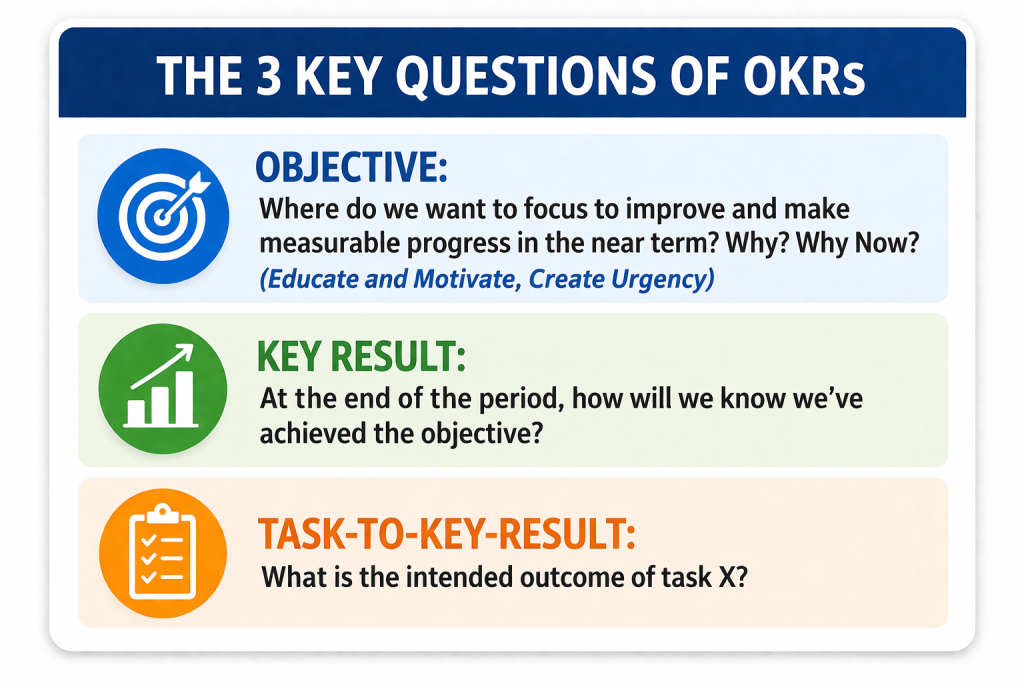
When teams “do OKRs,” they are continuously asking three essential questions:
- Where should we focus to make meaningful progress, and why now?
- How will we know we’ve achieved the objective?
- What is the intended outcome of the task or project we’re working on to move toware our objective?
This combination of focus, measurement, and alignment is what makes OKRs powerful.
To answer the question, “what are OKRs”, it helps to know that “OKRs” is more a verb than a noun. Next, it helps to drill down into three elements of this definition:
1 – Critical-thinking framework: When you are “doing OKRs,” you are asking a set of questions. These foundational questions of OKRs are:
2 – Ongoing discipline: You ask these questions every day, not just at the start of a quarter or at the end of the week. As well, you execute action plans and pivot as necessary to achieve desired results.
3 – Work together: Making progress at work often is not about “you” – but rather “us.” In business settings, as of 2026, individual-level OKRs are a thing of the past, creating your own OKRs makes it hard to “work together.” OKR teams often work better as cross-functional that “work together” rather than org-chart departments that “work in silos.”
It also helps to define ther terms “objective” and “key result” a bit more formally:
Objective – answers the question: “What will we focus our effort on as a team to make progress in near term?” It is one sentence, starts with a verb, and is qualitative.
Pro Tip: An objective should only be considered complete once your team aligns on 1-3 sentences about why it is important now.
Key Result – answers the question: “How will we know we’ve achieved (or made progress on) the objective by end of period?” There are three types of key results: metric, baseline, and milestone. Key results are quantitative, measurable, and specific.
Pro Tip: Key results should have a clear, standard way to track and measure progress.
Before going deeper, it helps to understand what are OKRs and how the framework works in practice. So let’s look at an example OKR.
Example OKR
This is a company-level OKR based on an actual 2026 client:
Objective: Grow membership with a focus on Product ABC and internal traffic sources
- Why: Membership of ABC is the lifeblood of our company.
- Why Now: EVENT X is causing a disruption which is driving membership down. Although we entering a new era with AI, we want to demonstrate that we can increase revenue to improve employee morale
Key Results: Objective achieved by Jan 31, 2026, as measured by:
- Increase monthly Freemium-to-Paid Conversion Rate from 1.0% (Jun-Sep) to 1.5% (Oct-Jan) (Stretch = 2%, Commit = 1.1%) KR Champion = Tony
- Increase Average Exponential Moving Avg (EMA) Retention Ratio (without Lifetime subs) from 1.2 to 1.4 % (Stretch =1.8%, commit = maintain at 1.2%) KR Champion = Janey
- Increase avg monthly internal traffic (non-affiliate sessions) from 8m visits (Jun-Sep) to 10m (Oct-Jan) (Stretch = 12m, Commit = 8.5m) KR Champions = Susan + Hans
To read more, check out our analysis of good and bad OKR examples from actual teams using OKRs. As well, you may want to review OKR rollout strategy which gets into how and if to rollout OKRs to teams and individuals.
Part 2. What Are OKRs: The OKR Cycle
Understanding the OKR cycle is essential to understanding what are OKRs and how the framework drives execution and learning. To make OKRs work, you begin by answering 10 questions that must be confirmed prior to launching OKRs as a foundation. For more on the OKR rollout process, check out our 3-phased approach.

Once you’ve answered the questions that must be confirmed prior to deploying OKRs, you train your team and training begin drafting real OKRs. Starting with a top-level OKR workshop to train leadership tends to work best.
Then, building off this momentum from the training workshop, you launch your first OKR cycle.
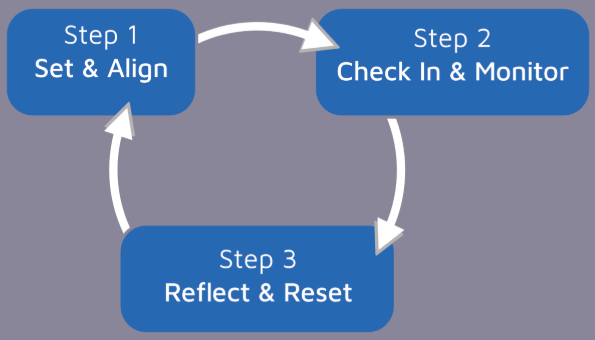
Cycles typically run 3-4 months. The 3-step OKRs Cycle consists of:
OKRs Cycle Step 1: Set and Align OKRs
In this step, you draft, refine, align, and finally publish your OKRs in a single location, your “OKRs Tracker.” Your tracker can be as simple as our field-tested OKRs Tracker spreadsheet which tends to work well when getting started or a dedicated OKR solution.
For more on step 2 and pitfalls to avoid, check out Ben on OKRs podcast.
OKRs Cycle Step 2: Check-In and Monitor
Publishing OKRs in a single location, the OKR tracker, is amazing. Your team is often excited and eager to make progress. It’s amazing to see an aligned list of your most important goals. The act of creating OKRs might make staff feel focused, aligned, and engaged. But this is often where OKRs programs fail due to the “set-it-and-forget-it” pitfall. So, to ensure OKRs get integrated into your daily work, you must focus on your OKR and execute!
For more on this critical step and pitfalls to avoid, check out Ben on OKRs podcast.
OKRs Cycle Step 3: Reflect and Reset
Reflect and reset is our personal favorite step in the OKRs cycle. Unlike a retrospective that focuses on looking back, this step features both a reflection on the past as well as a reset into the future. Here is where the rubber meets the road. To succeed with OKRs, you must capture what is working and not working. And even more critically, apply learnings to the next OKRs cycle.
For more on Reflect and Reset, check out Ben on OKRs podcast.
The OKR cycle consists of 3 steps: 1) Set and align OKRs, 2) Check-in and monitor progress, and 3) Reflect and reset. And we call it a cycle because it keeps repeating. The goal of the cycle is to align on your most important areas to focus on improving in the near term (step 1), execute and make progress in those critical areas (step 2), and then take what you learn to inform the next cycle’s OKRs (step 3).
It can be tricky to get the OKR cycle up and running, but once it’s in place, most teams manage to run the cycle without external support quite easily. An OKRs coach can be valuable when getting going to help you get through your first couple cycles. And a cycle is typically 3-4 months. The duration of the cycle is one of the 10 questions you must answer before launching your OKR program.
Now that we’ve defined how OKRs work, let’s get into the more pressing question: Why Use OKRs?
Part 3. Why Use OKRs?
Many leaders first ask what are OKRs, but the more important question is why organizations adopt the framework and what benefits they experience in practice. Organizations typically turn to OKRs to address common execution challenges:
- Lack of focus, too many priorities
- Lack of alignment across teams, especially as your organization grows
- Strategy is not clearly understood by employees
- Employees are busy, but not productive
OKRs provide structure, visibility, and prioritization to address these challenges.
The Seven Core Benefits of OKRs
After 200+ implementations, our clients report benefits in seven areas. The first five overlap with the original benefits as promised by John Doerr. The last two are additional benefits our clients have realized.
1 – Focus: OKRs help teams concentrate on the most important priorities rather than spreading effort across too many initiatives. With OKRs, “less is more.” As such, effective users of OKRs experience more focus, they reserve OKRs to reflect only their most important goals.
2 – Alignment: OKRs make priorities visible and connect efforts across teams toward shared goals. Also, by defining why an objective is important as well as measurable key results, teams align “why” and also are clear about “how progress will be measured.”
3 – Shorter Cadence: OKRs introduce a faster planning and execution rhythm that improves adaptability. This is often 3-4 months. Many organizations have a 2-week plan and annual plan in place, but lack this intermediate planning horizon. OKRs solves this problem.
4 – Engagement: When employees understand priorities and see measurable progress, engagement improves. People see how their work connects to the bigger picture and strategic business growth areas.
5 – Stretch Thinking: OKRs encourage ambition and push teams to pursue meaningful improvement rather than incremental change. Here is an analysis for setting a stretch-target-commit level for each KR.
6 – Common Goal Language: OKRs create a consistent framework for discussing priorities, performance, and progress across the organization. Everyone knows what ther terms “objective” and “key result” mean, preventing the confusion found in words like “goals,” “BHAGs” and “Big Rocks.” When you’re doing it right, no one is asking, “What are OKRs?”
7. Learning Culture: OKRs promote reflection, adaptation, and continuous improvement through regular review cycles. As a critical thinking framework, OKRs is a structured approach to asking questions – and this type of inquiry leads to a learning organization.
Together, these benefits strengthen clarity, execution discipline, and organizational learning. Listen to this episode of Ben on OKRs for more on Why Use OKRs.
Part 4. Brief History of OKRs
To fully understand what are OKRs, it helps to look briefly at how the framework evolved from Management by Objectives into the modern OKR approach used today. Andy Grove, CEO of Intel from 1987 to 1998, recognized the latent power in the Management by Objectives (MBO) as developed by Peter Drucker and created OKRs which we can think of as “MBOs 2.0.” Grove suggested setting objectives and key results more frequently, recommending quarterly or in some cases monthly.
Then, in 2013 Google Ventures partner Rick Klau released a video showing how Google used OKRs right from the start as inspired by John Doerr. After a couple OKR books came out in 2016 (Radical Focus by Wodtke and Objectives and Key Results by Niven and Lamorte), the popularity of OKRs spread beyond Silicon Valley and is now widely adopted across virtually all industries across the globe. Pretty soon everyone was asking: So, what are OKRs?
Part 5. What are OKRs? What are KPIs?
When learning what are OKRs, it is also important to understand how OKRs differ from KPIs and how the two systems work together. Unlike OKRs, the term “KPI” does not have a standard definition.
Often, all metrics are considered KPIs. One company might define a single KPI, another might define thousands. KPIs may be used to determine bonuses or to monitor overall company performance.
However, as we know from the analysis above, key results have a standard definition. They answer the question: “How do measure progress toward a given objective by end of the OKR cycle?”
OKRs and KPIs should work together.
See our detailed analysis here: How OKRs and KPIs compare.
Part 6. Why Some OKRs Programs Fail
Despite the clarity and benefits of OKRs, many organizations struggle to realize their full value. Implementing OKRs is not simply about writing objectives and key results. It requires disciplined thinking, alignment, and execution and it takes some time to get right. Even organizations that can answer the question “what are OKRs” may struggle with execution, alignment, or maintaining a consistent OKR cadence
In practice, organizations often encounter challenges such as:
- Reporting: Treating OKRs as a reporting tool rather than a thinking framework
- Tracking work: Writing key results that look like a to-do list rather than measurable outcomes
- Too many: Defining too many objectives, losing focus
- Set-it-and-forget-it: Publishing OKRs without integrating them into daily execution
- No Reflect & Reset: Failing to learn and adapt across cycles
These challenges are common, and they are solvable. In fact, across hundreds of OKR implementations, we have identified 40 common reasons OKRs fail, along with practical ways to address each one.
Part 7. Next Steps
If you now understand what are OKRs and how they work, the next step is exploring how to apply the framework effectively in your organization. If you’re looking to improve focus, alignment, engagement, or missing the shorter planning cadence or want to create a stretch culture, let me know and let’s explore how OKRs might benefit you right away!
Here are three of the ways we can help now:
- OKR Launch: Build a successful OKR system from the start and make it stick
- CEO Focus and Execution Workshop: Get immediate uptick in focus and execution without launching OKRs! Great for exploring.
- OKR Accelerator: Take an existing OKR program to the next level. Fix what’s not working, quickly and effectively.
Frequently Asked Questions About OKRs
What are OKRs in simple terms?
OKRs (Objectives and Key Results) are a goal-setting framework that helps organizations focus on priorities, align teams, and measure progress. An objective defines what you want to achieve, and key results define how success is measured — typically over a quarterly cycle.
What are OKRs and how do they work?
OKRs work through a repeating cycle of setting priorities, measuring progress, and reflecting on results. Teams define 1–3 objectives, attach measurable key results, check in regularly, and then reflect and reset before starting the next cycle.
What are OKRs compared to KPIs?
KPIs (Key Performance Indicators) typically monitor ongoing performance, while OKRs are designed to drive improvement and change. KPIs track the health of the business; OKRs focus teams on the most important areas to improve in the near term.
How often should OKRs be set?
Most organizations run OKR cycles for 3–4 months. During each cycle, teams hold weekly or biweekly check-ins to track progress and adjust execution as needed.
Do OKRs work for small companies?
Yes. In fact, smaller organizations often succeed faster with OKRs because alignment is easier and leadership involvement is more direct. OKRs work for startups, mid-sized companies, and enterprises alike when deployed correctly.
What are OKRs best suited for?
OKRs work best in organizations that want to improve focus, strengthen alignment across teams, and create a culture of measurable progress and continuous learning.
What makes OKRs successful?
Once leaders understand what are OKRs, success depends on executive ownership, clear and measurable key results, a consistent check-in cadence, and a structured reflect-and-reset process.
Still have questions about how OKRs would work in your organization? Want to talk live about “what are OKRs?”
Schedule a 30-minute OKR Diagnostic Session and get clear, practical guidance on how to implement OKRs successfully.


Recent Comments