

OKRs can turbocharge a business. Some leaders find them a superpower.
But traditional OKRs fail when cascaded to lower levels. The Impact OKR is a different kind of OKR, built bottom-up from each person’s strengths and values, then aligned with their manager.
This post is about why traditional cascading fails, what I’m doing about it, and what changed at OKRs.com.
A Policy Change at OKRs.com
As of May 2026, OKRs.com no longer offers OKR coaching below the leadership level.
We coach traditional OKRs at the leadership level only. This translates to top-level OKRs in the first cycle, with the option to set OKRs at the next level down if we believe it adds value. But the next level down is where we stop the top-down approach. Always.
This is not a casual position. It comes from twelve years of OKR coaching across more than 200 organizations. The pattern is consistent: leadership OKRs work, sometimes the next level down works, and below that the practice degrades into a compliance exercise. Christina Wodtke, who developed her own cascading approach years ago, has reached a similar conclusion: cascading more than two levels creates more drag than alignment.
I was about to leave OKRs as a profession. I did not want to support a practice that broke as it scaled down into most companies.
Then I found a way to engage individuals at scale that actually works, and it does not look like cascading.
A Different Way to Use AI With OKRs
A lot of people are using AI with OKRs right now. AI is refining key result, automating progress tracking, summarizing weekly check-ins, writing status updates. That work is useful.
We are using AI for a different purpose entirely. We are using it to surface what each person is built to do, their strengths, their values, their unfair advantage, before an OKR even gets written. The output is not a faster OKR. It is a fundamentally different kind of OKR: one that activates intrinsic motivation rather than imposing extrinsic tasks.
That instrument is the Impact OKR.
If you’re a CEO who read Measure What Matters, you probably ordered it for the entire leadership team. John Doerr’s book gave you the language for focus. It made you feel, maybe for the first time, that you could assert your own clarity into the organization. Objectives and Key Results cascaded from the top. But there’s been a bit of a backlash after the initial rush to roll them out.
And looking back, this is not surprising. Somewhere between the executive conference room and the front lines, the clarity your leadership team felt turned into a quarterly compliance exercise for most of your employees. The OKRs you cascaded down were yours. They were never theirs.
I’ve watched this pattern repeat. The literature says OKRs should originate bottom-up. The literature also says they must cascade down. Both cannot be true. Measure What Matters is a leadership mantra. It lets the CEO assert. Most employees are left with a bitter feeling when the OKRs show up, because the OKRs cascaded to them are not theirs.
The Impact OKR resolves the contradiction. It is not about measuring what matters. It is about doing what matters, both to the employee and to your organization. It originates with the employee, built from their own clarity work, and aligned with their manager. It turns 10 to 15 of your highest-leverage people into individual contributors who are finally doing the work they are built to do, pointed at outcomes your organization needs.
One OKR per person. One cohort. One 90-day cycle.
One OKR. Less Is More.
This is the non-negotiable, grounded in a mantra I’ve carried through a decade of OKR coaching: less is more.
In a work environment where Slack, meetings, and cross-team requests fragment every hour, one focus produces movement. Two dilutes your focus, and three can drown you. Most ignore this and define three, five, sometimes seven goals that are vague and disconnected from the person’s values or strengths. Six weeks later, the employee is busy but unfocused, and the manager has no visibility into what is actually moving.
The discipline to choose one Impact OKR is itself an assertion: a statement that this, above all else, is the work that matters this quarter.
3 Criteria: What Makes an Impact OKR Actually Work
An Impact OKR that transforms the manager-report relationship must satisfy three criteria simultaneously. If even one is missing, the OKR becomes a compliance exercise rather than a game changer.
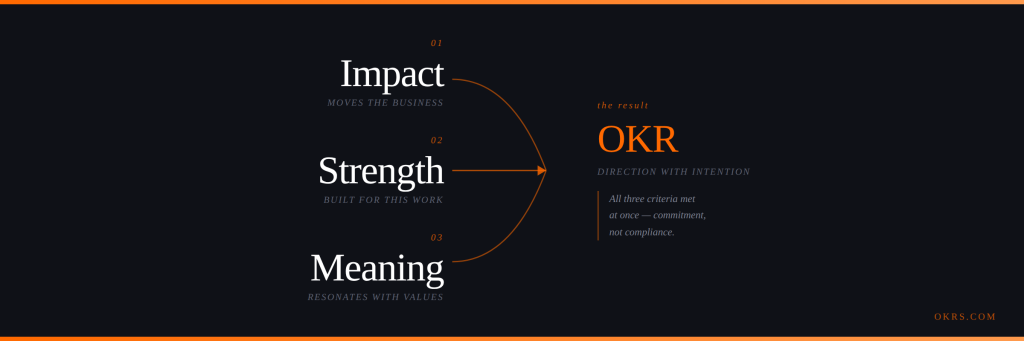
Criterion 1: Move the Business
An Impact OKR must move something that matters to the organization. The test is simple: if the manager’s manager asked what this person is working on this quarter, would the answer immediately register as something that matters? If not, the OKR is not impactful enough. This is the criterion most programs actually get right. It is business language, measurable, pointable. But impact alone is not enough.
Criterion 2: Activate the Unfair Advantage
An Impact OKR must require the employee to bring their actual capability to the work, not just their effort. When someone is operating inside their unfair advantage (the specific intersection of strengths, identity capital, and method only they hold) the quality of output increases, the energy cost decreases, and they finish the work energized rather than depleted. This is not about doing what is comfortable. It’s about doing what you’re built for. And yet, the unfair advantage alone is not enough.
Criterion 3: Be Intrinsically Meaningful
Here is the trap most frameworks miss: impactful work that activates your unfair advantage may still not feel meaningful. This is the criterion almost nobody uses, and it is the most transformative of the three. The employee must be able to articulate why the work matters to them personally, not just why it matters to the business.
I learned this firsthand. Early in my career I was the spreadsheet guy. The work was impactful. It activated a real strength. By the logic of Criteria 1 and 2, I should have been thriving. But the work didn’t connect to what I really cared about. That gap between competence and meaning is invisible until you name it. Once you name it, you can’t unsee it.
Compliance is not commitment. When the work connects to what someone truly cares about, you get discretionary effort, the kind that shows up on weekends and does not need to be managed. When all three criteria are present at the same time, the work is no longer just a job. It is an expression of who the employee is, directed at an outcome the business actually needs.
Three Types of Impact OKRs
The three criteria define what makes any Impact OKR work. The next question is what kind of Impact OKR a person should pursue. There are three, and together they cover the full territory of how an individual creates impact in a company.
Aligned OKR
An Aligned OKR ladders directly to a top-level company OKR. The person’s work moves one of the CEO’s headline priorities. This is the OKR a CEO sees and immediately recognizes as connected to strategy. Not every employee will have one. By definition, only some work directly advances the headline goals, and that is fine. When the alignment is real, it is powerful.
Strategic OKR
A Strategic OKR does not connect to a top-level OKR but is critical work that enables strategy to succeed over time. Think capability building, systems work, the infrastructure that makes future quarters possible. Without this kind of work, the headline OKRs eventually stop landing. Strategic OKRs are the long-term investment most organizations under-resource because they are not visible in the current quarter’s scoreboard.
Foundation OKR
A Foundation OKR keeps the business running at an acceptable baseline. Website uptime at 99.99%. Security patching. Budget reconciliation. Compliance work. None of this advances strategy. All of it has to happen, or the strategy never gets a chance to land. Most organizations treat Foundation work as invisible. Naming it as an OKR clarifies that it matters. It gives the people doing it real recognition for the discipline they bring.
The three types are mutually exclusive and collectively exhaustive. Every piece of meaningful work in an organization is either advancing a top-level OKR (Aligned), enabling future strategy (Strategic), or sustaining the baseline (Foundation). The Impact OKR system surfaces three options for each person. The coaching conversation identifies the primary recommendation, with a backup in the back pocket.
How Turbocharge Works: Two Phases
Phase 1 — Clarity: Identity Blueprint to Proposed Impact OKR
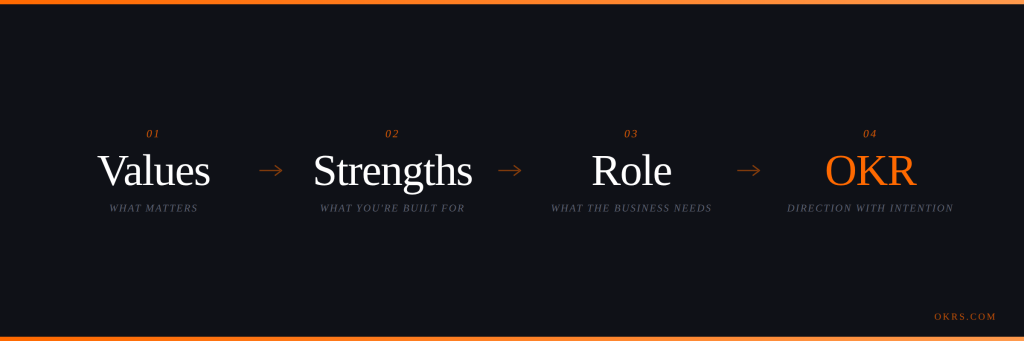
Each cohort member goes through the Identity Blueprint process. The Blueprint surfaces four things in structured, evidence-based form:
- Strengths: the innate capabilities the person brings to whatever they do.
- Identity capital: what they’ve built on top of those strengths over years of real work.
- Values: five to eight non-negotiables that determine which conditions produce flow and which produce drain.
- Unfair advantage: the specific intersection of strengths, capital, and method that only this person holds.
The Blueprint is then matched against the employee’s actual role, and the system proposes three candidate Impact OKRs. Each option satisfies all three criteria. A 30-minute coaching session refines the options and identifies the one OKR the employee will recommend to their manager, plus a backup. Before anything leaves Phase 1, the employee confirms the proposed OKR resonates. If it doesn’t, we refine until it does.
Phase 2 — Alignment & Execution: Manager Validation to 90-Day Cycle
Once the Impact OKR resonates with the employee, we align with the manager. The employee presents the OKR, grounded in their Blueprint, matched to their role, and the manager validates it against the team’s actual priorities. If the primary recommendation does not land, the backup option is on the table.
Where alignment holds, I coach each cohort member through a 90-day cycle with three touchpoints: kickoff, a midpoint check-in at Day 45, and a Day 90 reflect and reset.
Where alignment doesn’t hold, the CEO gets valuable data. Either the proposed Impact OKR needs refinement, or the role itself is misaligned with the person sitting in it. Both are findings worth surfacing before another year passes.
What This Looks Like in Practice
Here is a fully built Impact OKR, assembled from an employee’s Blueprint and matched to their role:
- Strengths: Strategic thinking, people development, execution
- Identity capital: Ten years across two scaling companies, operations leadership at each
- Values: Building teams, autonomy, meaningful work
- Unfair advantage: A diagnostic approach to operational bottlenecks that reframes them as coaching opportunities
- Role: Operations lead at a scaling company
- Resulting Impact OKR (Aligned): Build and coach a 5-person ops team that reduces cycle time by 30% while each team member develops one new leadership capability
Contrast the conversation that follows with the one most managers have today:
Without Turbocharge:
Manager: “What are your goals for this quarter?”
Employee: “I want to get up to speed and add value wherever I can.”
Manager: “Great. Let’s check in next month.”
Six weeks later: busy, unfocused, invisible.
With Turbocharge:
Employee: “My Impact OKR is to build and coach a 5-person ops team that reduces cycle time by 30% while each member develops one new leadership capability.”
Manager: “That’s exactly what we need. Let me bring this to my director.”
Six weeks later: progress is measurable, the boss’s boss knows this person’s name, and the employee is energized because the work activates their unfair advantage and aligns with their values.
Same person, same role, same company. Totally different trajectory.
The Four Breakthroughs
Breakthrough 1: Real Alignment Between Employee and Manager
In the traditional model, the manager assigns goals or the employee proposes them, there is a 20-minute conversation, goals get approved, everyone moves on. The OKR is a formality.
With an Impact OKR built on the Blueprint, something different happens. The employee comes to the manager with a proposal grounded in deep self-knowledge. It says: here is work that is impactful for the business, here is why it activates my unfair advantage, and here is how it connects to what truly matters to me. The manager now has a real conversation, not a goal-approval conversation, a clarity conversation. This is the conversation most managers have been waiting their entire career to have.
Breakthrough 2: The Boss’s Boss Effect
When the manager approves an Impact OKR this clear and this concrete, the manager becomes invested in it. They want to check in on it. They want to talk about it with their own leadership.
And when the manager’s manager asks “what is your team working on this quarter?” the manager doesn’t give a vague answer. They say: here is what each person is focused on, here is the impact we are going after, here is how it connects to the broader strategy. Suddenly, the boss’s boss is aware, understands, and, because the OKR is impactful, cares. This cascade happens automatically when the Impact OKR is built correctly. Traditional programs have no mechanism for it.
Breakthrough 3: Ruthless Focus in a Distracted Work Environment
A single, crisp Impact OKR turns every Slack message, every meeting invite, every side project into one question: does this move my Impact OKR? That single question, applied consistently, is a form of power most employees never develop because nobody has ever given them a framework to ask it.
Breakthrough 4: Measurable Progress on Meaningful Work
Theresa Amabile and Steven Kramer spent years researching what actually drives engagement in knowledge work. Their finding, documented in The Progress Principle, is both simple and underutilized: the single most powerful driver of engagement is making measurable progress on meaningful work. Not just meaningful work. Not just measurable progress. Both, together, consistently.
Most organizations optimize for one. They create meaningful work through mission statements and purpose workshops, but the progress is invisible. Or they create measurable work through KPIs and dashboards, but the work feels hollow. The three-criteria Impact OKR solves this by design: impactful, strengths-activating, and personally meaningful, all three, at the same time, measured on a 90-day cycle.
Who Turbocharge Is For
Turbocharge delivers one Impact OKR for every participant, built from their Identity Blueprint and aligned with their manager. It is for CEOs serious about focusing their most critical talent on the work that actually matters.
- CEOs of scaling companies who need their top 10 to 15 people focused on what moves the business, and aligned with the managers they report to.
- Professional services firms where the senior-associate cohort needs role clarity and measurable impact in the same cycle.
- Mid-size companies experiencing turnover in high-leverage roles, where losing the wrong person costs more than the program.
The Bottom Line
You already measured what matters. Turbocharge invites 10 to 15 of your highest-leverage people to do what matters, pointed at outcomes you need, powered by the clarity they’ve never been given the framework to build. One OKR each. One 90-day cycle. Fifteen transformed manager-report conversations.
Frequently Asked Questions
What is an Impact OKR?
An Impact OKR is a single role-based OKR built from the employee’s Identity Blueprint and aligned with their manager. It satisfies three criteria simultaneously: real business impact, activation of the employee’s unfair advantage, and intrinsic meaning to the person doing the work.
How is the Impact OKR different from a traditional OKR?
A traditional OKR cascades down from leadership. An Impact OKR is built bottom-up from the employee’s own clarity work, then aligned with the manager. A cascaded OKR is assigned. An Impact OKR is asserted.
What are the three types of Impact OKRs?
Aligned OKRs ladder directly to a top-level company OKR. Strategic OKRs enable long-term strategy without connecting to a current top-level OKR. Foundation OKRs sustain the baseline of the business so strategy can happen on top of it. The three types are mutually exclusive and collectively exhaustive.
Why only one Impact OKR per employee?
Less is more. In a distracted work environment, one focus produces movement. Two dilutes. Three drowns. The discipline to choose one Impact OKR is itself the assertion.
What are the three criteria?
A strong Impact OKR must satisfy three criteria at once. It drives real business impact. It activates the employee’s unfair advantage, the specific intersection of strengths, capital, and method only they hold. It resonates with personal values and feels intrinsically meaningful. If any one is missing, the OKR becomes a placeholder rather than a real commitment.
Does OKRs.com still coach OKRs at the team or individual level?
No. As of May 2026, OKRs.com coaches OKRs at the leadership level only — top-level OKRs and, when it adds value, the next level down. Below that, top-down cascading stops. Individual-level work happens through Turbocharge, which is a fundamentally different methodology built on the Identity Blueprint rather than on cascading.
If you are ready to explore what Turbocharge looks like for your organization, let’s talk.
Want a one-page overview to share with your leadership team?
⬇ Download the Turbocharge Two-Pager (PDF)


Recent Comments