


OKRs for Agile teams sounds like overkill. CareerBuilder thought so too. They were already shipping, sprints were humming, velocity charts looked great. Why a High-Performing Agile Team Still Needed OKRs: The CareerBuilder Story.
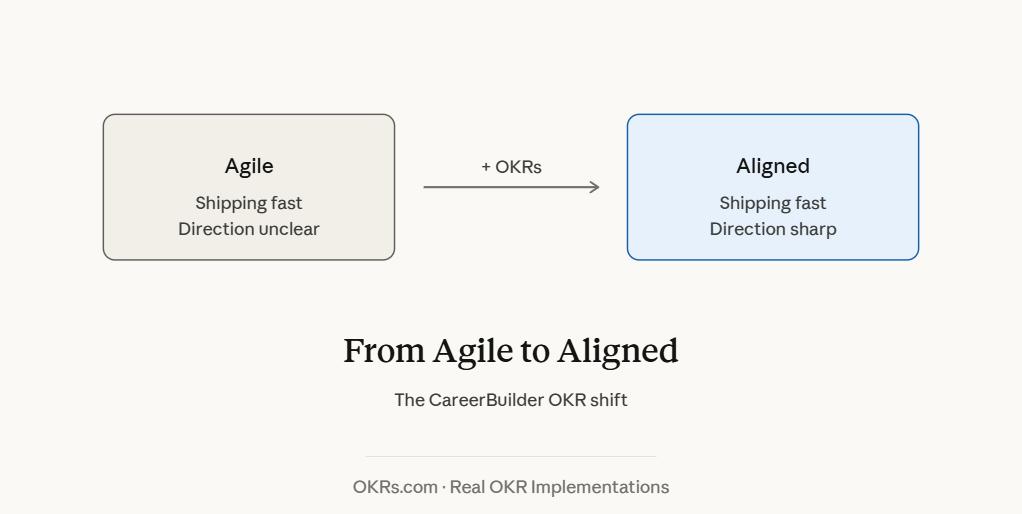
CareerBuilder was already Agile. Teams were shipping. Sprints were humming. Velocity charts looked great.
So why bother with OKRs and what are OKRs anyhow?
That’s the question Andy Krupit, Manager of Agile Development at CareerBuilder, set out to answer. And the answer turned out to be the most interesting OKR story I’ve heard in a while.
The Hidden Problem with OKRs for Agile Teams
Here’s the uncomfortable truth about high-functioning Agile teams: you can move fast and still drift.
Sprint after sprint, teams at CareerBuilder were delivering. But somewhere between the standups and the retros, a quieter problem was forming. Teams could tell you what they were building. They had a harder time explaining why.
For a company serving 24 million monthly visitors and 92 percent of the Fortune 1000, that gap matters.
Three Reasons CareerBuilder Brought in OKRs for Agile teams
When Andy and his team made the case for OKRs, it came down to three things:
- Focus on what matters most, not just what’s in the backlog
- Alignment across teams that rarely talked to each other
- Accountability through what Andy calls “positive tension from the business”
That third one is worth pausing on. Positive tension isn’t pressure. It’s the productive friction that happens when business outcomes and team execution have to meet in the middle.
The Rollout That Worked Because It Was Small
A lot of OKR rollouts fail because someone tries to launch them everywhere at once. CareerBuilder did the opposite.
They started at the team level. Workshops. Drafting sessions. Alignment checks. Refinement conversations. No big bang, no all-hands launch, no software rollout the day before quarter-end.
The shift teams went through was subtle but profound: they stopped tracking tasks and started measuring outcomes.
The Five Whys Breakthrough
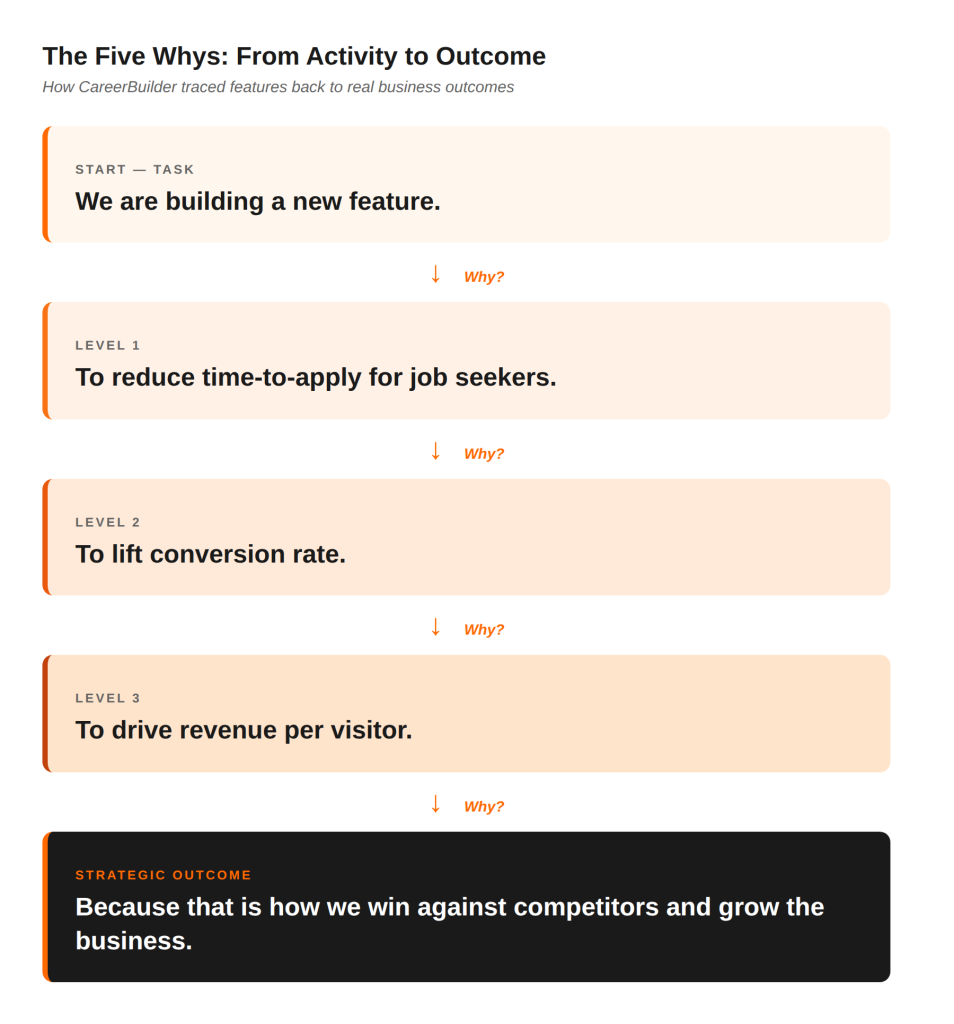
The “aha moment” didn’t come from a template or a tool. It came from a single question, asked over and over:
Why?
Using the five whys technique, teams pushed past activity (“we’re building this feature”) and into strategic intent (“because we’re trying to reduce time-to-apply for job seekers, which lifts our conversion rate, which drives revenue per visitor”).
Once teams could trace their work back to a real business outcome, two things happened:
- They cut their objectives down. Fewer goals, sharper focus.
- They found out they shared objectives with teams they barely knew existed.
The Real Result Wasn’t a Metric
Yes, focus improved. Yes, alignment got tighter. But the deepest change at CareerBuilder was cultural.
Teams that had been operating in parallel started collaborating. Skeptics became believers. The conversations in the room shifted from “are we on track for this sprint” to “are we still working on the right thing.”
That’s the part you can’t put on a dashboard.
The Lesson for Anyone Leading OKR Implementation
If your teams are executing well but you can sense the strategy getting fuzzy, OKRs aren’t a productivity tool. They’re a clarity tool.
The best part of OKRs isn’t the framework. It’s the conversations the framework forces you to have.
Listen to the Full Story of OKRs for Agile Teams
Andy walks through the entire CareerBuilder journey in Part 4 of the Real OKR Implementations series, including the workshop structure, the refinement cadence, and what he’d do differently next time.
🎧 Listen to the episode below.
Stuck on OKRs?
Book a free 30-minute strategy call. We’ll diagnose what’s blocking your team and you’ll leave with two or three concrete next steps, whether or not we end up working together.


Recent Comments