


Learning how to score OKRs correctly is critical to driving focus, alignment, and real progress
Introduction
Understanding how to score OKRs is one of the most misunderstood aspects of the framework.
Are your Key Results stretch goals?
Are they commitments?
Are you following the approach from Measure What Matters?
Are you using Radical Focus?
Or are you applying a Stretch–Target–Commit model?
If your organization is not aligned on how Key Results are scored and how progress is tracked during the OKR cycle, confusion and misalignment will follow.
Scoring is not a technical detail. It shapes expectations, behavior, and learning.
Objectives Should Not Be Scored
First, a critical clarification: Objectives should not be scored.
Objectives describe direction. They are qualitative and aspirational. The measurable component of OKRs lives in the Key Results. When organizations attempt to score objectives directly, debates become subjective and time is wasted!
The focus on how to score OKRs should be on scoring Key Results. As it is the scores on the KRs that determine the overall progress on the O.
Why Scoring Matters More Than You Think
Without a clear scoring standard:
Teams may misjudge success
Leaders may interpret results differently
Stretch goals may feel like failure
Commitments may be treated casually
Early warning signals may be missed
Clear scoring criteria reduce ambiguity and strengthen execution discipline.
Three Common OKR Scoring Approaches
In practice, most organizations follow one of three scoring philosophies.
1. Radical Focus Model for How to Score OKRs
In this model, Key Results are all 50% likely to be hit – they are difficult but attainable. And at the end of the period, the scoring is simple – it’s binary: you either achieve the Key Result or you do not.
This approach drives accountability and clarity. However, if applied rigidly, it may discourage ambitious stretch thinking.
2. Measure What Matters Model for How to Score OKRs
In John Doerr’s framework, there are two types of key results. For aspirational KRs, a score of 0.6 to 0.7 can be considered strong performance. This encourages bold goal setting. However, it requires leaders to clearly communicate that less than perfect does not equal failure. In this model, there is another type of KR, which are known as “commitment KRs” that MUST be hit at 100%. In practice, many teams write mostly commit KRs that look a to-do list.
3. Stretch–Target–Commit Model for How to Score OKRs
In this model, we try to build off the best of both Wodtke’s Radical Focus and Doerr’s scoring approachs by defining three thresholds upfront:
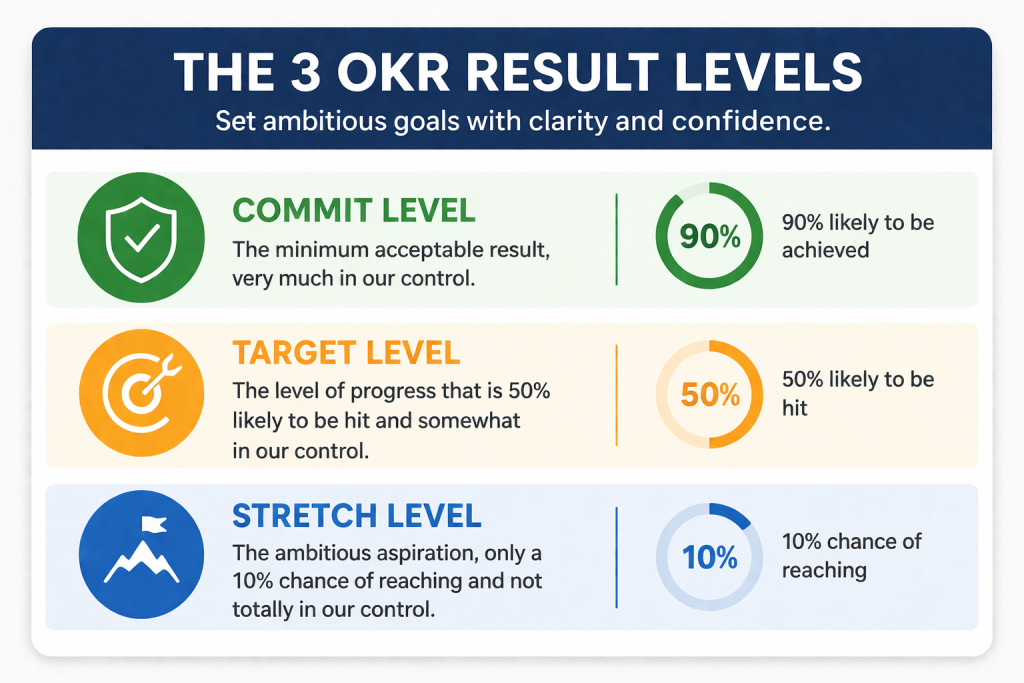
This approach reduces ambiguity by defining expectations in advance. It forces critical conversations early in the cycle about what success truly means.
Many organizations find this model balances ambition with accountability.
Define How to Score OKRs at the Start
One of the most powerful practices in OKR implementation is defining scoring criteria when the Key Result is written.
Ask:
What does success look like?
What is a true commitment?
What does amazing look like – to get that stretch level?
These conversations prevent disappointment and misalignment at the end of the cycle. Clarity early avoids conflict later.
How to score OKRs Progress During the Cycle
Scoring at the end of the cycle is important. But tracking progress in an OKR tracker during execution is even more critical.
There are two ways to think about progress.
How to score OKRs with Historical Progress
Historical progress answers: What has happened so far?
For example:
Revenue increased from 10 million to 11 million
Conversion improved from 3 percent to 4 percent
Churn decreased from 12 percent to 10 percent
How to score OKRs: Predictive Progress
Predictive progress answers:
Based on current trends, are we likely to achieve the Key Result?
Predictive scoring acts as an early warning system. It allows leaders to intervene before the end of the cycle.
If your organization only reviews historical data, corrective action may come too late.
Beyond Numbers: Add a Health Indicator
Numbers alone do not tell the full story.
A Key Result may appear numerically on track while hidden risks emerge:
Dependencies slipping
Resource constraints
Quality issues
Customer resistance
Adding a qualitative health signal such as green, yellow, or red can surface risks early.
Scoring should support transparency, not perfection.
Scoring Is a Learning Tool, Not a Performance Review
One of the most common mistakes is turning OKR scoring into individual performance evaluation.
When scoring becomes punitive:
Teams avoid stretch
Ambition declines
Risk-taking disappears
OKR scoring should serve as:
A communication tool
An expectation management tool
A learning mechanism
A feedback loop
The goal is improvement, not judgment.
Signs Your Scoring System Is Misaligned
Your approach to scoring may need adjustment if:
Teams debate what counts as success
Stretch goals feel demotivating
Leaders interpret scores differently
Key Results lack defined thresholds
End-of-cycle conversations feel defensive
These signals suggest your scoring model lacks clarity
How to Design a Clear Scoring Standard
To strengthen your OKR scoring system:
Decide which scoring philosophy your organization will follow
Define stretch versus commitment clearly
Align leaders on expectations
Establish predictive progress tracking
Separate OKR scoring from individual compensation
Consistency builds trust. Listen to Ben talk about OKR scoring here:
How to Score OKRs: Final Thought
How you score OKRs shapes how your organization behaves.
Stretch without clarity creates frustration. Commitment without ambition creates stagnation.
A clear, aligned scoring model drives stronger execution and better learning throughout the OKR cycle. And, it also does a job of communicating and managing expectations.
If you would like help designing a scoring and progress tracking approach that fits your organization, request a 1:1 consultation with me, Ben Lamorte.


Recent Comments