

Most companies that adopt OKRs abandon them within two cycles. They schedule the kickoff meeting, run the workshop, write the first set of OKRs, hold a check-in or two, and then quietly let the framework slide back into the drawer next to the last management initiative.
The reason is almost always the same. They never answered one question before they started: why OKRs?
Not “why does Google use OKRs.” Not “why did our CEO read the book and like it.” Why does this company, at this moment, need a new operating discipline? What specific problem will OKRs solve that nothing else has solved?
When that answer is clear and specific, OKRs work. When it is vague, borrowed, or missing, OKRs fail.
This guide explains the real reasons organizations adopt OKRs, the difference between a weak “why” and a strong one, and how to define a purpose that actually drives execution.
What Are OKRs?
OKRs stand for Objectives and Key Results. The framework was popularized by Andy Grove at Intel, refined by John Doerr in Measure What Matters, and adopted by Google before spreading across thousands of companies worldwide.
An Objective describes a meaningful direction or priority. It is qualitative and answers the question: what is the most important area where we want to make measurable progress now, and why?
Key Results define how progress toward that objective will be measured. They are specific, measurable, and time-bound.
At their core, OKRs help organizations shift from tracking activity to measuring outcomes. For a deeper breakdown, read What Are OKRs.
The Real Problems OKRs Solve
Organizations turn to OKRs to address four common execution challenges. Naming which one applies to your company is the first step toward a strong answer to “Why OKRs.”
1. Lack of Focus. Too many priorities competing for attention. Every initiative looks important. Teams spread effort thin and nothing meaningful ships.
2. Misalignment Across Teams. As organizations grow, departments develop their own goals and lose sight of how their work connects. Engineering builds what marketing did not ask for. Sales chases deals that customer success cannot support.
3. Strategy That Employees Cannot Articulate. Leadership believes the strategy is clear. Employees disagree. The disconnect is invisible until execution stalls.
4. Initiative Overload. Every quarter brings new programs, new tools, and new priorities. Nothing ever gets killed. Eventually the organization is doing too much to do anything well.
OKRs provide structure, visibility, and prioritization to address these challenges. But only if you can name which one is yours.
The Seven Benefits of OKRs
First, let’s acknowledge the 4 benefits that Doerr shared in his benefits slide below:
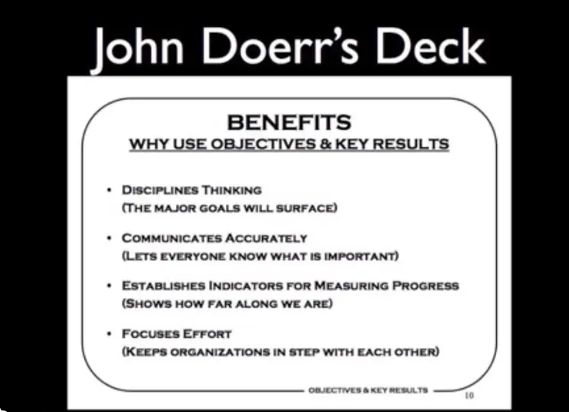
Now, that’s great Mr Doerr! But, after doing hundreds of implementations, we’ve seen seven consistent benefits emerge. The first five are taken directly from John Doerr’s research. The last two we added based on our consulting work.
1. Shorter Cadence. OKRs run on quarterly cycles, which forces faster planning, faster execution, and faster learning than annual goal-setting.
2. Focus. Teams concentrate on three to five priorities instead of fifteen. The discipline of choosing what matters most is the discipline of saying no to everything else.
3. Transparency and Alignment. OKRs make priorities visible across the organization. Cross-functional dependencies become obvious before they become crises.
4. Engagement. When employees understand priorities and see measurable progress, engagement improves. People want to win at work. OKRs show them what winning looks like.
5. Stretch Thinking. OKRs encourage ambition. Setting a target that requires you to grow rather than coast pulls more out of teams than incremental goals ever do.
6. Common Goal Language. OKRs create a consistent framework for discussing priorities, performance, and progress across departments. Teams stop talking past each other.
7. Learning Culture. OKRs promote reflection through regular review cycles. Missed targets become data, not blame.
Together, these benefits strengthen clarity, execution discipline, and organizational learning. But none of them activate without a clear answer to the why question.
Why Defining Your “Why” Matters
Most employees are busier than ever. To gain commitment to OKRs, leadership must clearly explain why the organization is adopting them and how employees will benefit. Every organization should develop its own answer.
Without a clear “why,” OKRs become a compliance exercise rather than a strategic discipline. Teams fill out the templates because they were told to, not because they believe the framework will help them win.
Weak “Why OKRs” vs Strong “Why OKRs”
The difference between a weak and strong reason for adopting OKRs is the difference between imitation and intention.
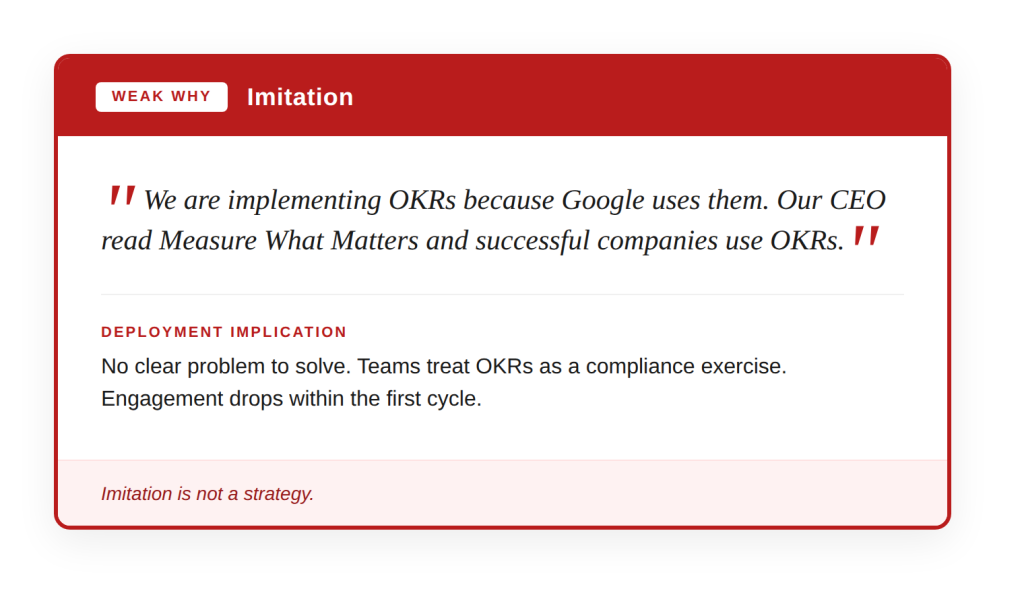
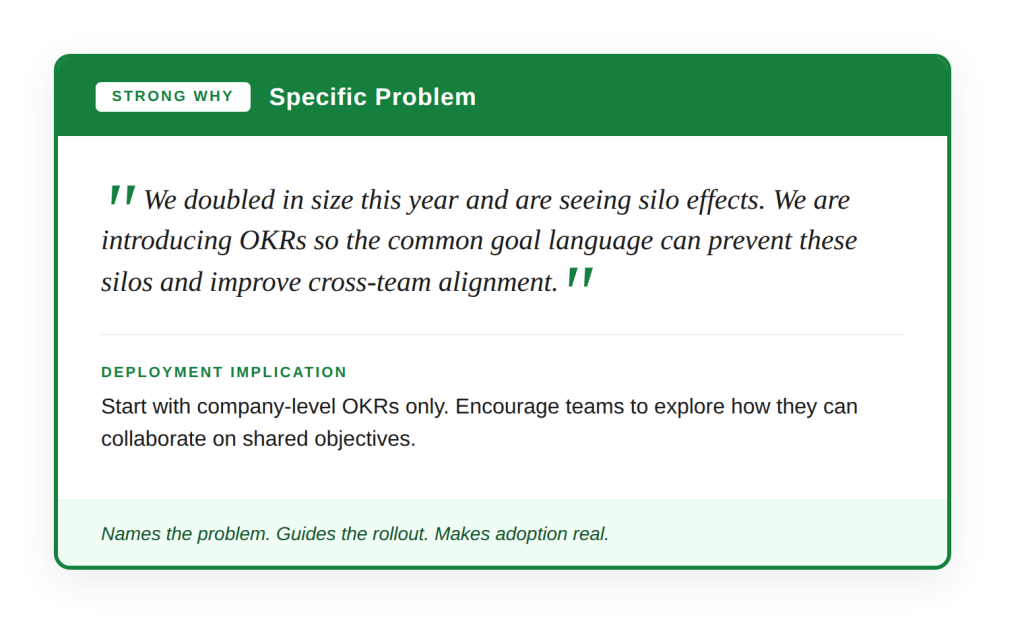
A weak “why” copies what other companies do. A strong “why” names a specific problem the organization cannot solve without a new operating discipline. The strong version guides every deployment decision that follows. When the answer to “why OKRs” is wrong or missing, OKRs fail in predictable ways.
Three Real Examples of Strong “Why OKRs” Answers
The most effective reasons for adopting OKRs identify the specific problem leadership is trying to solve. Here are three real CEO perspectives from our consulting work.
Example 1: Cross-Functional Alignment
“We have doubled in size over the past year. As we scale, we are seeing silo effects typical of larger organizations. Wh OKRs? To preserve our collaborative culture, we are introducing OKRs. We believe the common goal language of OKRs can prevent these silo effects and improve alignment across teams.”
Deployment Implication: Start with company-level OKRs only. Encourage teams to explore how they can collaborate to achieve shared objectives. Resist the urge to cascade OKRs down through every team in the first cycle.
Example 2: Focus
“We have too many potential projects. If we try to do everything, we risk failing in many areas rather than succeeding in our core growth priorities. Why OKRs? We are introducing OKRs to help us focus on what matters most.”
Deployment Implication: Define one OKR per team focused on a single high-priority area for improvement. The goal is not to capture all work. The goal is to drive focus on the work that matters most.
Example 3: Communicating Strategy
“As a leadership team, we believe our strategy is clear. However, employees tell us they do not understand it. Why OKRs? We are adopting OKRs to communicate our strategy consistently and ensure alignment from the top.”
Deployment Implication: Start with company-level OKRs and reinforce them through regular communication, such as quarterly all-hands meetings where leadership explains the connection between OKRs and the broader strategy.
Each of these CEOs named a specific problem. Each problem suggested a specific deployment approach. That is what a strong “why” looks like in practice.
Why OKRs vs KPIs?
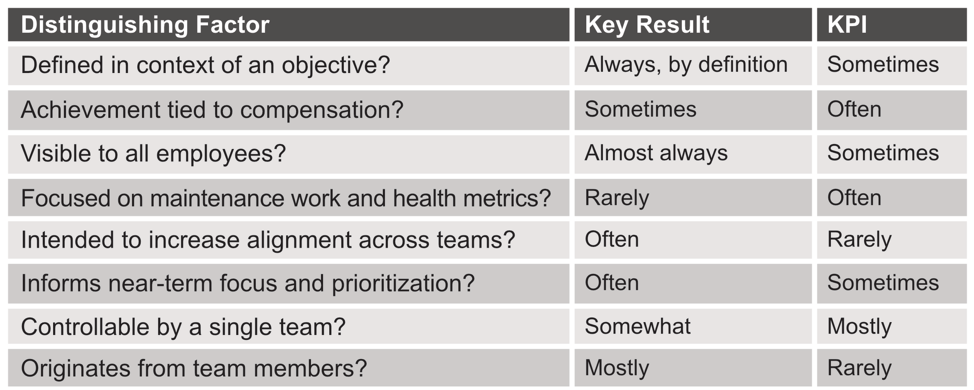
KPIs vs KRs (Source The OKRs Field Book)
OKRs and KPIs serve different roles. KPIs track ongoing performance and organizational health. OKRs drive change and improvement.
Most organizations use both. KPIs monitor what is, OKRs focus effort on what could be. For more on how the two work together, read OKRs vs KPIs.
Listen: Why OKRs Fail Without a Clear Why
In this episode of the OKRs Podcast, I walk through real client conversations where the difference between a strong and weak “why” determined whether the OKR initiative succeeded or stalled within the first quarter.
The Question That Determines Everything
OKRs are not just a goal-setting tool. They are a system for focus, alignment, execution, and learning. But their effectiveness begins with a clear answer to one question:
Why use OKRs?
Organizations that define a compelling and specific purpose are far more likely to see meaningful results. Organizations that skip the question end up with a framework no one believes in.
If you would like help clarifying your organization’s purpose for adopting OKRs, request a free consultation below.


Recent Comments