

Introduction
Many organizations begin implementing OKRs by starting with a simple OKR template. A good OKR template provides structure for writing Objectives and Key Results and helps teams focus on measurable outcomes rather than tasks.
However, the most effective OKR templates do more than organize information. They help teams think clearly about priorities, outcomes, and measurable progress.
In practice, successful OKR programs should distinguish between two complementary templates:
- an OKR drafting template to write strong Objectives and Key Results (this can be done anywhere)
- an OKR tracker template to monitor progress during the OKR cycle (all OKRs in one place)
Together these templates support the full OKR lifecycle, from drafting priorities to tracking execution and learning from results.
If you are new to the framework, you may want to start with What Are OKRs.
Implementing OKRs in Your Organization?
Many leaders search for an OKR template because they want to begin using OKRs quickly.
However, writing strong OKRs can be more challenging than it appears. Teams often struggle with:
- writing Key Results that measure outcomes instead of tasks
- aligning OKRs across teams
- maintaining a consistent review cadence
If your organization is exploring OKRs or trying to improve an existing implementation:
👉 Request a 1:1 OKR Strategy Call with Ben
A short conversation can often help clarify how OKRs should work within your organization.
What Is an OKR Template?
An OKR template is a structured format that helps teams define and manage Objectives and Key Results.
Most OKR templates include:
- an Objective describing the focus area
- several Key Results measuring progress toward that objective
- context explaining why the objective matters
- a mechanism to track progress throughout the OKR cycle
Templates are useful because writing strong OKRs requires clear thinking about outcomes, not just activities.
The templates below help teams structure that thinking.
Example OKR Template Structure
An effective OKR template typically follows this structure:
Objective
→ Why / Why Now (THIS IS THE MISSING PIECE IN MANY TEMPLATES!)
→ Key Result 1
→ Key Result 2
→ Key Result 3
The Objective defines the focus area, while Key Results measure the progress the team expects to achieve.
OKR Template for Drafting
The OKR drafting template helps teams write clear, outcome-focused OKRs before entering them into a tracking system.
This structure encourages teams to think carefully about focus, motivation, and measurable progress.
Team / Mission
Identify the team responsible for the OKR and its mission within the organization.
Objective
Objective: _______________________________
The Objective describes the most important area your team should focus on to make measurable progress.
Guidelines for writing strong Objectives:
- Write the Objective in one sentence
- Begin with a verb such as Improve, Grow, Drive, Increase, Launch, or Strengthen
- Focus on direction and intent, not measurement
Helpful question:
What is the most important area your team should focus on to create meaningful progress?
Why / Why Now?
Why / Why Now: _______________________________
Write three to five sentences explaining why this objective matters.
This section provides context and motivation before defining the Key Results.
Include:
- why the objective is important
- why it matters now
- how it connects to higher-level strategy or company OKRs
A clear “Why” helps teams understand the purpose behind the objective.
Key Results
Key Results answer a simple question:
How will we know we have achieved the objective?
Key Results should ideally be written as measurable outcomes.
A common structure is:
Increase metric A from X to Y.
Key Result 1
Key Result: _______________________________
Commit: _______________________________
Stretch: _______________________________
Key Result 2
Key Result: _______________________________
Key Result 3
Key Result: _______________________________
Key Result Scoring Criteria
When drafting Key Results, it helps to define multiple performance thresholds.
- Commit: What we expect to achieve. Highly controllable within the team (about 90 percent likelihood).
- Target: Progress that meaningfully moves the needle. Difficult but attainable (about 50 percent likelihood).
- Stretch: An exceptional outcome that is still possible (about 10 percent likelihood).
This scoring approach helps teams balance ambition with realism. Learn more in OKR Scoring.
Fundamental OKR Questions
When drafting OKRs, three questions guide the conversation.
What is the Objective and why does it matter?
What area should the team focus on to improve and make measurable progress in the near term? Why now?
What Key Results will show progress?
At the end of the OKR cycle, how will we know we have made progress toward the objective?
What outcomes should tasks produce?
For each initiative, ask:
What measurable outcome should this task produce? This helps ensure work connects directly to results.
Characteristics of Effective Team-Level Key Results
Use this checklist when evaluating Key Results.
- Key, not all. Key Results represent the most important outcomes, not every activity.
- Specific. Clear language improves communication and reduces ambiguity.
- Measurable. Progress should not rely on opinion.
- Results, not tasks. Key Results measure outcomes rather than activities.
- Clear. Use simple language that anyone in the organization can understand.
- Stretch. Ambitious goals often produce stronger results.
- Scored. Agreeing on scoring criteria improves transparency and learning.
- Bottom-up. Most Key Results originate from teams, while Objectives often originate from leadership priorities.
For examples of strong OKRs written using this approach, see OKR Examples.
OKR Tracker Template
Once OKRs are drafted, teams need a simple system to track progress during the OKR cycle.
An OKR tracker template helps teams monitor progress, identify blockers, and capture lessons learned throughout the quarter.
👉 Click here to see a sample OKR tracker.
In the tracker, each row represents a Key Result. The columns follow the natural rhythm of the OKR cycle.
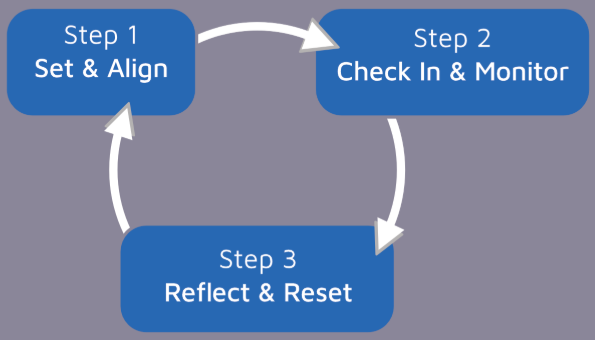
OKR Template Supports the Full OKR Cycle
The OKR tracker is designed to support the the 3 steps of the OKR cycle.
Step 1 Set OKRs
The first columns capture the Objective and Key Results defined during the drafting process. This includes the Key Result description, commit and stretch levels, and the Key Result champion responsible for progress.
Step 2 Check In and Monitor Progress
During the quarter, teams update the tracker regularly with current progress, confidence levels for achieving the target, blockers, and action plans.
These updates help teams focus on solving problems rather than simply reporting status.
Step 3 Reflect and Reset
At the end of the OKR cycle, teams record the final Key Result value and capture lessons learned.
The team then decides whether to keep, modify, or remove the Key Result for the next cycle and drafts improvements where appropriate.
This reflection step helps teams continuously improve their OKRs.
Why Many OKR Templates Fail
Templates alone do not guarantee successful OKRs.
Common mistakes include:
- writing tasks instead of measurable results
- setting too many objectives
- failing to connect OKRs to strategy
- not reviewing progress regularly
These challenges are discussed in more detail in Why OKRs Fail.
How to Use an OKR Template Successfully
Organizations often download an OKR template, but the real value comes from using the template as part of a disciplined execution process.
A successful OKR template should support:
- clear strategic priorities
- measurable Key Results
- regular progress tracking
- reflection at the end of each OKR cycle
When these elements are present, OKRs become more than a template. They become a system for improving focus, alignment, and measurable progress.
For real-world implementations, explore OKR Case Studies and Examples.
Need Help Implementing OKRs?
Writing strong OKRs is harder than it looks. Many organizations discover that the real challenge is aligning teams and defining measurable outcomes.
If your organization is exploring OKRs or trying to improve an existing implementation:
👉 Request a 1:1 OKR Strategy Call with Ben


Recent Comments