


Most organizations think OKR alignment is about structure.
They draw neat diagrams.
They connect boxes with arrows.
They cascade goals from the top down.
And then they wonder why alignment actually gets worse. If your teams are copying and pasting OKRs instead of thinking critically about what matters, you don’t have alignment, you simply have an administrative system for compliance.
Before we talk about how to align OKRs the right way, I am going to tell you what not to do: the direct cascade.
The Wrong Approach: The Direct Cascade
The direct cascade begins with OKRs at the highest level, which is a good starting point. However, it requires lower-level OKRs to be subsets of higher-level OKRs.
John Doerr famously illustrated cascading with his hypothetical football team example, showing how higher-level key results become lower-level objectives.
We’ve also seen OKR software vendors demonstrate cascading diagrams, describing higher-level key results as “parents” and lower-level objectives as “children.”
It looks clean and and logically is intuitive, but it rarely works (if ever) in practice unless you are building OKRs for a pro football team!
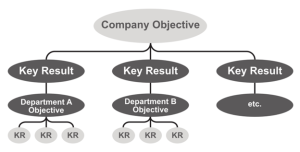
Direct OKR Cascade
Why the Direct Cascade Fails
1. It violates the distinction between objectives and key results.
An objective is qualitative and directional. A key result is quantitative and measurable. Here are some examples of good and bad OKRs at both top-level and team-level.
In a cascade, higher-level key results become lower-level objectives, which kind of makes me get confused. The whole point is that OKRs have qualitative objectives with quantiative key results, so how can an objective become a key result? It seems like this approach blurs the most critical distinction in OKRs!
2. It discourages critical thinking and reduces accountabilty/ownership.
When lower-level teams begin by copying and pasting OKRs instead of creating meaningful objectives through discussion and analysis, they are just going through the motions – they don’t take the time to develop their own goals.
3. It reinforces silos.
If each top-level key result is “assigned” to one team, that team focuses narrowly on its slice and returns to its silo — reducing cross-functional alignment rather than strengthening it. Why should department A care about department B’s OKR if they are not working together to make progress on an important higher-level key result?
Every organization we’ve seen attempt a strict direct cascade has struggled. And often, cascading reduces alignment rather than improving it.
So the question becomes: if cascading doesn’t work, what does?
How Real Alignment Happens
Real alignment does not come from arrows connecting boxes. It comes from conversation, clarity, and shared understanding. We recommend that each team document how their objectives align to top-level strategy (and/or horizontally with other teams) as part of their “Why” and “Why Now?” analysis.
Alignment is confirmed through discussion, not diagrams with arrows. Let’s look at an example from one of our clients.
Using “Why” and”Why Now?” to Confirm Alignment
Instead of copying and pasting a higher-level key result, teams should ask:
Why is this objective important right now?
How does it support company strategy?
How does it support other teams?

Use Why and Why Now to Align OKRs
The example above shows how one platform team determined that migrating stores off a legacy database was the most important area to focus on in the near term. The CTO was losing sleep over the fact that some of the old databases were literally on DOS and only something like 5 engineers knew how to make edits to their old system and 4 of them lived in another country! Notice that their proposed objective did not map to a top-level OKR; it had basically nothing to do with “expanding into mobile products.”
However, when the team lead discussed the objective with the CEO and explained why it was critical now, alignment was achieved. Alignment happened the moment leadership agreed. No arrows required!
The objective was still valid, even though it did not directly connect to the company’s objective of expanding into mobile products. OKRs are valuable in these cases because they make sure you have the right conversations at the right time to drive alignment as you align OKRs.
A Practical Three-Step Alignment Approach
Inspired by practices used at leading organizations:
Step 1: Leadership sets direction
Leaders review prior results, share key learnings, and provide direction for the next period. Teams then draft and refine OKRs using this context.
Step 2: Teams align through discussion
Teams connect their OKRs to shared priorities through conversation, not strict cascading. When alignment is unclear, leaders and teams clarify together. Not all work must map directly to higher-level OKRs.
Step 3: Publish transparently
All OKRs are shared in a common tracker where anyone can view and comment. Transparency strengthens alignment across teams and reinforces shared understanding.
Alignment improves through visibility, conversation, and shared commitment.
Coaching Takeaways to Align OKRs
DO
Use higher-level OKRs as context for lower-level thinking
Require each team to explain how their objective connects to strategy through “Why Now?”
Confirm alignment through leadership discussion
DO NOT
Use the direct cascade approach to define OKRs
Turn a key result into a lower-level team’s objective
Set lower-level OKRs by copying and pasting higher-level OKRs
Strong alignment is not created by structure alone. It emerges from conversation, clarity, and shared commitment that enables teams to work together toward meaningful outcomes.
If you’re struggling with alignment in your OKR program, schedule a 1:1 OKRs consultation. We’ll identify the structural gaps and design a practical path forward to align OKRs and get your team moving in the same direction.


Recent Comments